Tag Archives: Politics

Rachel Goldberg-Polin teaches: “There is a time to sob and there is a time to dance, and we have to do both right now.”

Trying to share Hersh’s mom’s words (above) everywhere I can, AND I wrote this list back in October 14, 2015. I think I had written and said different versions of this list many times over the course of many years. Here it is on my blog now.

I can’t believe I have to say this, but here we go:

Not all Arabs are Muslim.

Not all Muslims are Arab.

Not all Americans are Christian.

Not all Israelis are Jewish.

Not all Israelis agree with every policy of the Israeli government or the Israeli police force. [See some coverage of recent Israeli protests here: https://www.972mag.com/israel-hostage-protest-movement-government/]

I can support Israel, call myself a Zionist, and still disagree with things that happen in Israel.

I can love Israel and fear for Israelis’ safety, and still think critically about how they protect themselves from terrorism.

I can love Israel and my Israeli friends and family and simultaneously care about Palestinian people and people who live in Gaza and anyone who HAMAS victimizes anywhere. NB: the fierce women of Iraq: https://www.jpost.com/j-spot/article-765306!

If you are reading this post and you are surprised, please go read more about the situation. Maybe try +972 Magazine or ALBI. Our buddies at NPR and the New York Times don’t always present all sides of the story – partially because the story is 2,000 years old and because there are not only two sides to this story.

If you are surprised that I am posting this, please know that I don’t want to have to, but every once in a while, I am surprised and disappointed by how ignorant/naive/hateful some smart people are. (Sorry for the run-on sentence.)

FYI: If you are inspired to write a comment about how terrible I am or how I’ve “learned the wrong lesson from October 7, 2023,” please save your time/energy. I’m not going to read it. Here’s a quarter. Call someone who wants to hear from you.

The Sunflower: On the Possibilities and Limits of Forgiveness, by Simon Wiesenthal

We invite you to a book discussion in observance of Holocaust Memorial Day – Yom HaShoah. We invite your participation and your questions. 

Lunch & Learn 

with Rabbi Vered L. Harris and Rabbi Susan E. Lippe

Thursday, April 24, 12-1pm

In-Person or Via Zoom Meeting ID 857 4813 1977

Temple B’nai Israel, Oklahoma City, OK

in observance of Holocaust Memorial Day – Yom HaShoah

Shalom, shalom. This is my list of discussion questions for a class about The Sunflower: On the Possibilities and Limits of Forgiveness, by Simon Wiesenthal (Originally published in 1969.) 

[We probably won’t get to all of these questions and/or these questions in this particular order. We are looking forward to including participants’ questions as well.]

The main question for this book is – Should Simon have forgiven the Nazi? Would you have forgiven the Nazi? That is the question that concludes the book. It seems essential to our discussion of the book, but it doesn’t have to be our first discussion question. [I would add to Wiesenthal’s question. What do you think it means that he never told the Nazi whether or not he forgave him? Would you have done it differently? Was he waiting for forgiveness or an answer?]

Does everyone deserve to die in peace? Why or why not?

What does it mean to “lose feelings?” What does it mean to “lose feelings for death?” Do you have any experience like this? What do you think they mean? OR: do you think this experience is limited to torture, trauma, and/or an attempted genocide? Why or why not? Related: Do you think the encounter with the dying Nazi re-ignite some feelings in Simon? 

Do you believe that the Nazi had truly repented? Why or why not? How would that change what you think about Simon’s response and/or your own response?

Why do you think the Nazi want Simon to have his things? Do you think Simon should have accepted them? Why or why not? Would you have accepted them? Why or why not?

What do you think about collective guilt? Wiesenthal comments on the collective guilt/shame of the Germans. “The question of Germany’s guilt may never be settled. But one thing is certain: no [contemporary] German can shrug off the responsibility. Even if he has no personal guilt, he must share the shame of it. As a member of a guilty nation, he must share the shame of it. As a member of a guilty nation he cannot simply walk away like a passenger leaving a tramcar, whenever he chooses. It is the duty of the Germans to find out who was guilty.” (93) Do you agree with Wiesenthal? Why or why not?

Personal Note: I’m offended by people who ascribe behavior to God in the Holocaust. We have no idea about what God was doing/thinking during the Holocaust. I think that it’s possible God shortened the Holocaust and/or saved a remnant of Jews, but I cannot know because I’m HUMAN. This is why this is not a question for our book discussion.

General Notes: 

So many people were affected by the Holocaust – Jewish and non-Jewish people, hetero- and homosexual people, people from all socio-economic classes, and more. We would like to share this topic/discussion with as many people as possible. Please feel free to invite any interested folks among your Jewish and non-Jewish friends and neighbors. Forgiveness is a universal value. Anyone who wishes to learn with us is welcome. Temple B’nai Israel is a welcoming place for people of color, people of any gender and/or sexuality, people with disabilities – for everyone. 

We recommend this book for readers ages 13 and up.

Talking about the Holocaust is hard. We strive to make this a calm, respectful, welcoming event focused on learning. However, talking about antisemitism, hate, murder, torture, and other events/ideas related to the Holocaust can bring up challenging emotions for anyone. We will understand if you don’t feel like talking and/or staying in the room for the full hour.

I don’t use the word genocide when discussing the war between Israel and Hamas. Here’s why.

I’ve been holding on to this criticism for a long time – even before October 7, 2023 – criticism for a lot of liberal thinkers who seem new to the issues surrounding the State of Israel and the occupations. I understand that a lot of liberal Americans see this recent war as a war of strong, bully Israel wiping out Palestinians. I want to lay out some nuances of this particular situation in regards to genocide. I know there are people out there

As someone whose family members found refuge in the Land of Israel between 1920 and 1930, I’ve been invested in the history of Israel for a long time. In tenth grade, my American family went to Israel to reunite with our Israeli family members. My father’s mother had not been able to contact her cousin and best friend since 1921, when she boarded a ship to Ellis Island. You can probably understand that my introduction to Israel was about gratitude for this miracle, especially knowing most of their/our family members had died because of terror in Europe. The Nazis and their allies worked hard to wipe out the Jews. Some of us survived.

I’m a big, fat, liberal, loudmouth American Jewish Zionist feminist. Of course most of my Israeli best friends are liberals who protested against Netanyahu long, long before this war. I have Israeli cousins and Israeli friends who are also active progressives like me. When Trump won the first time, one of my Israeli best friends said: “Now you know how I feel.” Of course I have always hated Netanyahu like it’s my job. Of course my heart breaks for ALL people who suffer. Of course I pray for a cease fire and all the hostages home safe.

Some American liberals accuse American Zionists like me of quibbling over the definition of genocide because we don’t want to look closely at the horrible situation. (See below for a useful definition.) To me, that take sounds tone deaf. Many of us don’t use that word casually because we have had to look closely at systematic violence before.

I encourage you to consider the resonance of the word genocide with European Jews who barely escaped Nazi death camps to make it to relative safety in Israel. I think it’s hard for Jewish Israelis and their allies to hear the word genocide applied to Israel while so many Israelis live peacefully next to Israeli Arabs, Israeli Muslims, and Palestinian Israelis – inside the State of Israel.

I know that the Nazi attempt at genocide is not the only example, but it’s the one Americans and Europeans seem to know best. (See below for resources on the attempted genocide in Rwanda and the attempted genocide of Native American peoples.)

The Nazis collected Jews from every country, state, anywhere they could. To liberal Zionists like me and my Israeli friends, what has happened in Israel since October 7, 2023 is a Gaza-specific issue – a war about security. I recognize and mourn and call out the deep suffering of the Gazans – Palestinians, journalists, and other people there. I don’t avoid the word genocide to downplay the horrific tragedies occurring in Gaza. Rather, I avoid the word genocide because words have meaning. Using the word genocide to describe Israel’s war against Hamas is inaccurate, and it feels purposefully divisive.

I know that the Israeli government, the Israeli military, and the various Israeli police forces of Jerusalem and other cities do unethical and tragic violence against people in the name of protecting Israel. I don’t defend the horrific and sometimes genocidal threats some Israeli leaders have made about Palestinians, today and in the past. I would never defend the crimes against humanity committed by Netanyahu and his crew, AND Israel is fighting a war against Hamas. I do not agree with the way Israel treats the people of West Bank and Gaza, AND Israel is not attacking Palestinians outside of Gaza. This is not a genocide attempt.

My friend Avi reminds me that there are people who use the term genocide to describe Israel, knowing full well how it resonates with many Jews. Using the word genocide to describe the violence in Gaza often causes Jews, Israelis, Zionists, and others to shut down dialogue – no matter how empathetic we may feel with the suffering of the Palestinians there. In moments of clarity when I’m writing on this blog, I wonder what their goals are, especially when they paint all Zionists or all Jews with the same brush. I pray for more interactions that open hearts and open dialogue rather than shutting individuals down or shutting groups out. I hope we can all find opportunities for more real conversations to broaden and deepen our understanding; more dialogues to build relationships.

In conclusion, I hope we can all learn to speak and listen so we can build more understanding. I pray and protest for this violence to be over. I pray and march for the safety of all Israelis – not just because some of them are my family and friends. I also pray for the end of all violence against everyone, Palestinians included – for peace and safety in the Middle East. Of course I don’t want any more people to die – not in the West Bank, not in Gaza, not in Israel, not anywhere. I don’t know how we can build that kind of peace – but I hope more and more of us can work together towards peace and safety for ALL. Truly, I pray that more of our allies join the active war against Hamas.

Here are a few relevant readings I can’t stop thinking about:

Here is a piece on the origin of the term genocide: https://www.facinghistory.org/resource-library/raphael-lemkin-genocide-convention

Here is a helpful definition of genocide: https://www.ushmm.org/genocide-prevention/learn-about-genocide-and-other-mass-atrocities/what-is-genocide

The NIF Blog is a great way to learn more about progressive forces in Israel. Sokatch writes well-researched, well-nuanced updates about current events in Israel. I also recommend signing up for their emails.

We Wish to Inform You that Tomorrow We Will Be Killed with Our Families: Stories from Rwanda, by Philip Gourevitch

Here are two resources about the attempted genocide of Native American peoples: https://hmh.org/library/research/genocide-of-indigenous-peoples-guide/ and https://www.history.com/articles/native-americans-genocide-united-states

This is a powerful argument by Tomer Persico against applying the term genocide to Israel: https://heb.hartman.org.il/colonialistic-settlement/?fbclid=IwY2xjawJ0yINleHRuA2FlbQIxMQBicmlkETFXZFhjTGtmUmwzc1d5aTRKAR69wWBq4GtnSkpshPpdwfdDn7e1tCULk7j8u_BJiZMu_8eW4lx76ycr_UKsDg_aem_SD5efweHp5geJs4hlLH2hA

The Sunflower: On the Possibilities and Limits of Forgiveness, by Simon Wiesenthal

[Note: I’m teaching The Sunflower on April 23, 2025 in observance of Holocaust Memorial Day. Please join us by Zoom, if you can – through Temple B’nai Israel of Oklahoma City.]


More Resources for Current Events, Including Israel

Note: No one is Objective. Nothing is Objective. Some journalists are better researchers than others. Some journalists include context better than others. In addition to grammar, I definitely seek out reliable research and context in my reading.

Many friends have asked me for recommendations of resources on current events affecting Israel, Israelis, Zionists, and anti-Zionists. (This post is not about books. That will be a separate post.) I’m sad I have to repeat this: Not all Arabs are Muslim. Not all Muslims are Arab. Not all Palestinians live in Gaza or the West Bank. Some Palestinians are Israeli citizens. Not all Israelis are Jewish. Not all Jewish Israelis are white. Not all Israelis agree with every policy of the Israeli government or the Israeli police force (even if one of my cousins is part of the Jerusalem police force). I can support Israel, call myself a Zionist, and still disagree with the Israeli government. I can love Israel and fear for Israelis’ safety, and still think critically about how the Israeli military and Israeli police forces protect themselves from terrorism. I can love Israel and my Israeli friends and family, and still care about people in Gaza and the West Bank. Also, Israeli is at war with Hamas. If you are surprised that I am posting this, please know – I don’t want to have to, but every once in a while, I am surprised and disappointed by how ignorant/naive/hateful/narrow some smart people are. (Sorry for the run-on sentence.)

Note: Here is an interesting one-off explanation of Arab Israeli citizens. https://www.cfr.org/backgrounder/what-know-about-arab-citizens-israel

Here are some journalism recommendations:

I really believe in lifting up Arab-Israeli, Muslim-Israeli, and Palestinian-Israeli voices. I asked friends for more Palestinian Israelis to read/hear. My Israeli friend Or suggested I read more of Lucy Aharish and Suleiman Maswadeh. Also, Or and I love Renny Grinshpan who I mainly watched for comedy until she became an activist on October 7, 2023. Now, I love her even more. My Israeli friend/brother Niv recommends: Idan Nimsto on Insta and on Twitter/X. Idan Nimsto is probably for the young and young at heart, but this hip, musical Israeli (Lin-Manuel-Miranda-style) teacher made this FANTASTIC video – Give Palestine Back? – You don’t have to agree with it to learn from it.

Haaretz is a liberal Israeli paper which has always included journalists from the non-white and non-religious Jewish population of Israel. Yes, Haaretz costs money, but it’s worth it.

My parents strongly recommend the PBS News Hour on every topic for every American. If you can’t be home at the right time to sit still for live news, you can follow them on social media. That’s a fun mash up of traditional news and “new media.” On Instagram and Threads, they are @newshour. On Instagram, you can also get direct reports from the IDF.

I like + 972 Magazine – I don’t agree with everything they say, even though I’m pretty liberal. I think a lot of Americans like it for their authentically Israeli criticism of Israel’s government.

I also like The Times of Israel. My smart, logical professor Dr. Steven Windmueller contributes to that paper frequently. He loves context and history and research. If you are an American Jew who is wrapped up in American politics and concern for Israel/Israelis, he’s a great person for you to read.

I love the emails from the New Israel Fund. You don’t have to donate money to get their emails, but you might want to. I also like the UnXeptable website for updates and press releases. [UnXeptable started as a grassroots protest movement against the Israeli government, but turned into a grassroots community support org on October 7, 2023. Thanks to my activist sister-from-another-mister Hadar Peled for the connection to UnXeptable way back when it was the Kaplan Street protest movement.] I have heard that “mainstream media” organizations don’t address the situation of the hostages in Gaza regularly, so I recommend visiting the Bring Them Home website and/or Instagram account to find out more – even when there isn’t big news.

For very personal takes on current events, I strongly recommend both Parents Circle and Combatants for Peace. I love these organizations who emphasize working together. These aren’t either Israeli or Palestinian. Both of these organizations lift up voices from all sides of the story. Find them both on all the socials. Please share their stories. They are working towards PEACE FOR EVERYONE EVERYWHERE. Please help them get the attention they deserve for doing the challenging work of building real relationships across borders. [Again, we don’t have to agree with their every word to celebrate their values.]

Friends & Neighbors: Many of you are probably wondering why I didn’t recommend the New York Times. I like a lot of stuff about the NYT. Their games are awesome. I love the magazine and the book review section. I really like Emily Bazelon and Tressie McMillian Cottom. Also, I don’t think the New York Times is reliable on deeply controversial issues like Israel. I’m not the only one to recognize that the New York Times is not as open to the wider world context as people say/expect. For example, here is the full letter that over 180 of the NYT’s own contributers signed and sent about the paper’s on-going biased reporting on transgender life in America. By all means, read the NYT – as long as you read it with your critical thinking skills turned up to 11. There is no perfect newspaper, of course. So, please don’t let the NYT be your only or even main source for news on Israel. NPR and the New York Times don’t always present all sides of the story – partially because the story is over 2,000 years old. Partially because there are more than two sides to this story. See above!

I admit that I’m not super loyal in the way I consume news. In the course of any given week, I’ve probably read articles in all of the news outlets I listed above plus a couple extra ones local to the story I’m chasing. Additionally, for world news, I like The Guardian. Paying for The Guardian is definitely worth it. (I get most of my Ukraine news there, for example.) I don’t read the same papers every day which is why I try to tell my friends to send me articles they really love or hate too. Hint. Hint.

Thank you for listening. Feedback welcome.

May peace prevail on earth – for my people, for your people, for all the people everywhere.

#GunSense

Every once in a while, your rabbi quotes one of your other rabbis, and your heart swells with affection. Yesterday, Rabbi Neil Blumofe quoted Rabbi Paul Kipnes, who was my rabbi-supervisor at Gindling Hilltop Camp in the early 90s (and one of my “big brothers” among the “Pacific Area Reform Rabbis”).

My heart was already full yesterday morning: A) The Torah scroll that was read & lifted yesterday was scribed by a female soferet. B) I was sitting next to my lovely friend Yaira, across from my adorable friend Chris, and looking around a beautiful Jewish sanctuary filled with amazing people. C) I was praying with a Jewish community who loves liturgical Hebrew.

My heart was also broken: It takes me a few days for mass shootings to sink into my brain. At first, Shock – How can there be another mass shooting? How many kids died this time? Again?! Next, Anger – How did no one stop this troubled teen? How is it so easy for a kid to get guns, bullets, and alone time to mount a full-scale attack on a school? Also, Confusion – How is it possible that we live in a so-called advanced society and we don’t recognize the importance of safety for our children? How can we not agree on the most basic of needs for the most vulnerable of humans?

Then, in his sermon, Rabbi Blumofe cited Rabbi Kipnes’ blog:

Two by Two: Saving the Children
From the Storm of Bullets
Raining Down on their Heads
By Rabbi Paul Kipnes

In his poetic charge, Rabbi Kipnes implores all of us to:

Join an organization that reflects your views
Or Send a check to a candidate that reflects your views
Or Attend a rally to reflect your views
Or Make a donation to a group that reflects your views
And then
Encourage two friends to do two by two

So, I wanted to amplify this message and add my two cents.

1. Contacting our elected representatives – I know that postcard parties and sending emails are easier for the introverts than calling. I personally do not enjoy talking on the telephone either. However, everything I’ve read, for example, from INDIVISIBLE suggests CALLING is more effective than mail of any sort. Our mail and email just gets counted and reported as statistics – and we know what conservative politicians do with stats. However, actually CALLING during business hours takes up the office staff’s time. When the staffers report to their bosses, our elected representatives, they report that our CALLS take time away from the rest of their productive work day. That’s GREAT. Let’s do that. CALL. CALL. CALL. Keep a list in front of you. Crochet while you are on hold. Do whatever you can to force yourself to make these calls on the regular. (I’m going to do this awkward thing and link you to a blog post I already wrote about this: A New Resistance.)

2. We were on fire during the first 3 or 4 months of this American presidency. I know that my senators complained about the phone calls we snowflakes were putting in. Let’s get that fire back. If our team can run this marathon of resistance NOW, then it won’t turn into a full 8 years of this presidency. (Heaven, help us.)

Here is a pep talk from EVERYTOWN.org

throw them out.jpg

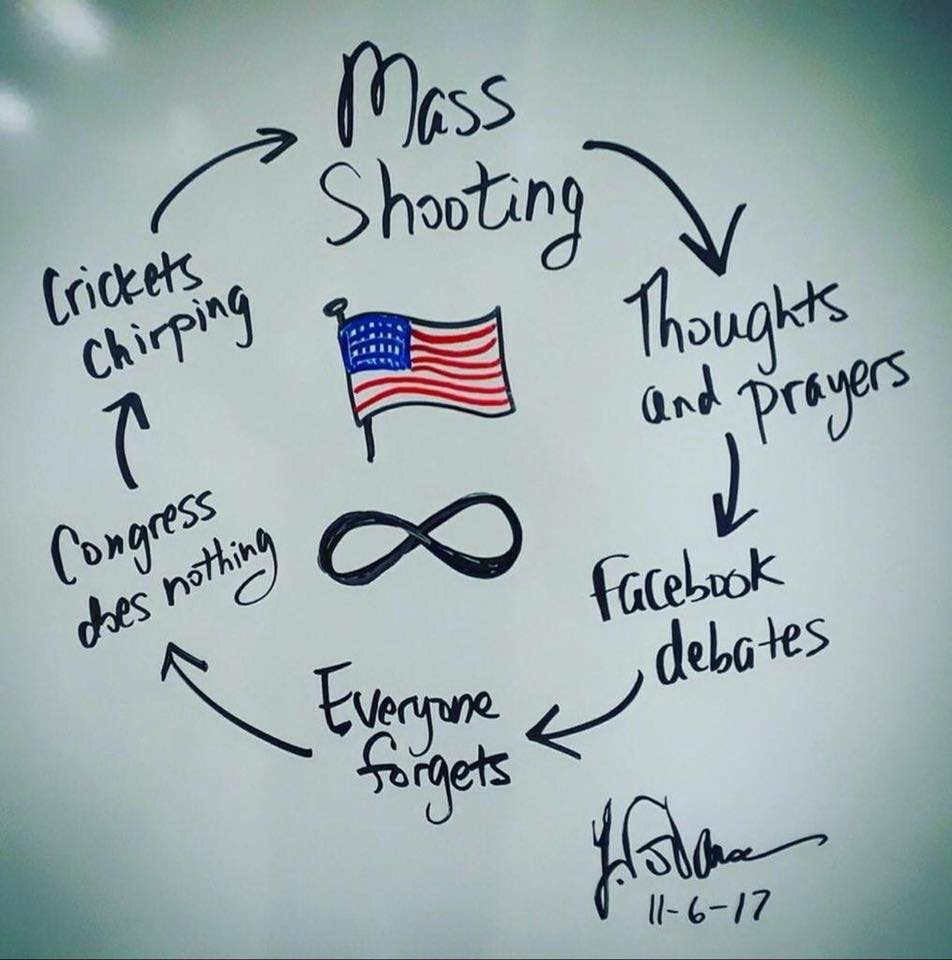
I found this scary drawing (below) on a friend’s Facebook page.

We CANNOT let this be our future.

mass shootings.jpg

A New Resistance

GOOD MORNING, AMERICA. HOW ARE YOU?

For the next 4 weeks, I’m going to make these 6 phone calls every day, except Shabbat. I wanted to give myself a limited time to see if I could pull it off without pulling my hair out.

Today, I want to let them know that I oppose Sessions appointment to Attorney General. He is unfit to serve.

Day One:
Cornyn’s Washington office: Can’t reach a staffer, though there are many rabbit holes to follow on the options menu. They all lead nowhere.
Cornyn’s Austin office: Busy signal.

Cruz’s Washington office: Their voicemail inbox is full.
Cruz’s Austin office: Found a lovely, yet repetitive human! (It only took about 5 tries.)

In William’s DC office, a lovely human being named Elise answered the phone and listened to my concern. Super polite.
William’s Austin office: Voicemail inbox full…….

On my way out of town, I might stop by Cornyn’s 6th Street office – just to check to see if he is okay!
Senator Cornyn, you’re not answering ANY of your telephones, ARE YOU ALRIGHT?

Note: It only took about 20 minutes to call, including trying each number a few times and talking the two people I actually reached.